
IMEG Uses Arkio to Review Complex Healthcare Spaces in XR
 Johan Hanegraaf April 24, 2026
 Discover how IMEG uses Arkio to bring clients inside complex healthcare environments, test equipment layouts in real time, and make design decisions earlier with more confidence.
If you want to see this workflow discussed live, we also hosted Abby Coleman from IMEG for an Arkio session focused on collaborative design workflows in XR. You can watch the full recording on YouTube here.
About IMEG
IMEG is a national engineering design firm with more than 3,000 employees across over 100 offices in the United States. The firm specializes in high-performance building systems design across healthcare, higher education, industrial, infrastructure, and commercial projects.
Abby Coleman, IMEG's Innovation Extended Reality Specialist, is based in St. Louis and works with a 20+ member Innovation team. Her role focuses on leading the implementation and adoption of extended reality technologies across the firm, working closely with engineers, project teams, and clients to bring tools like virtual and augmented reality into real project workflows.
"Traditional collaboration tools often make it hard for clients and team members to fully visualize the end result," Abby explains. "A lot of the process relies on drawings and 2D markups, which can lead to extra meetings just to clarify intent."
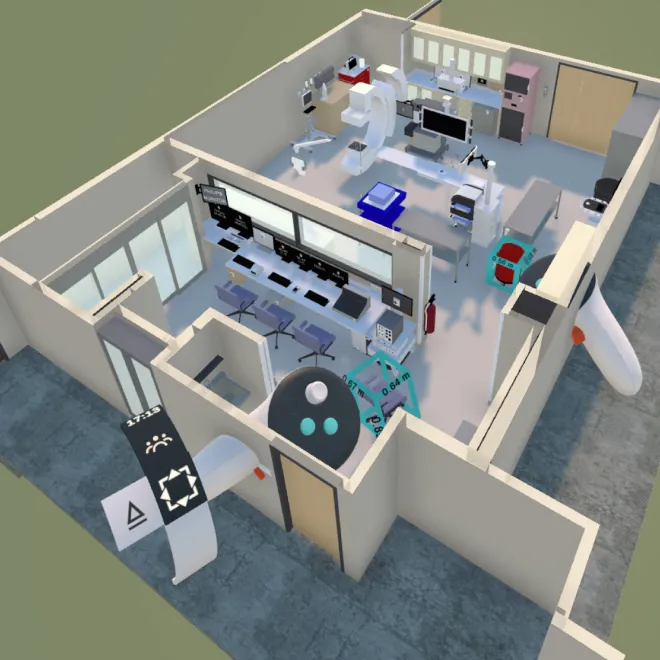
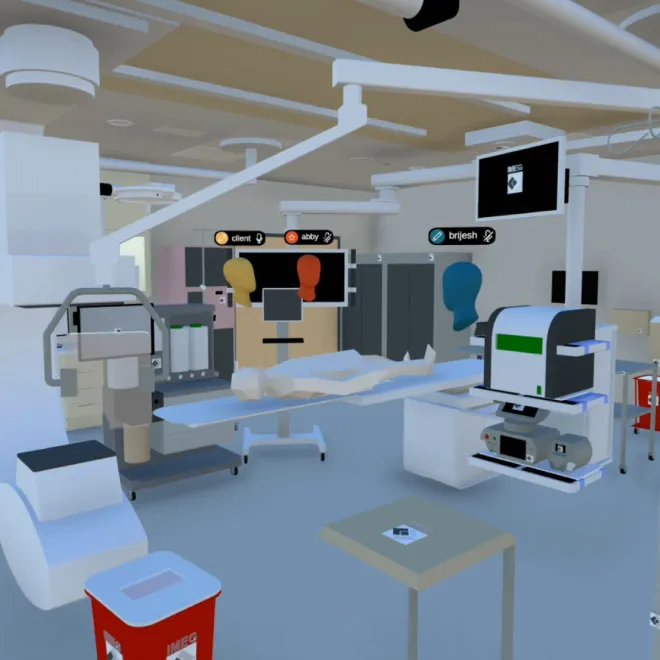
From Drawings to Immersive Understanding
Abby has been interested in VR since the first Oculus headsets appeared. "As a hands-on learner, immersive technology really resonated with me," she says, "because it allows me to understand spaces and ideas in a more tactile way." She was first introduced to AR and VR during her internship at IMEG through the IDEA Program, and that exposure eventually led her to pursue the role full-time after graduating.
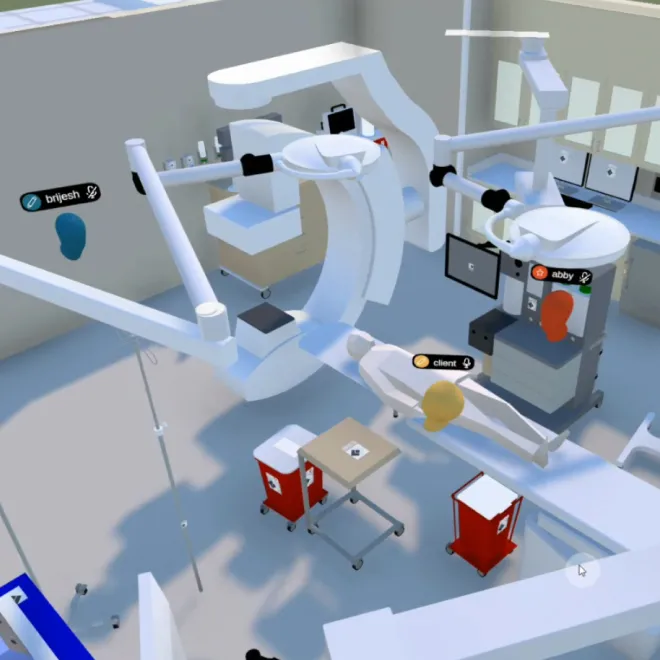
Abby has worked on many healthcare projects and one of Abby's favorite uses of VR was a surgical suite renovation covering an entire hospital floor. The team facilitated both remote and in-person immersive reviews of several critical operating rooms, allowing the client and project team to walk through the spaces together, evaluate layouts, and make informed decisions before construction began. Those sessions were not just well received, they were useful: participants rated them around 9 out of 10 for helpfulness.
Today IMEG uses Meta Quest 3, Quest 3S, and Quest Pro headsets together with Arkio and Autodesk Workshop XR to support immersive design reviews and collaborative model exploration with both project teams and clients.
Solving Equipment Planning at Full Scale
For IMEG, Arkio stands out because it makes design conversations more interactive. "One of the features we really appreciate about Arkio is the ability to move and manipulate Revit families directly within the immersive environment," Abby says. "This allows us to explore 'what if' scenarios in real time with clients and project teams."
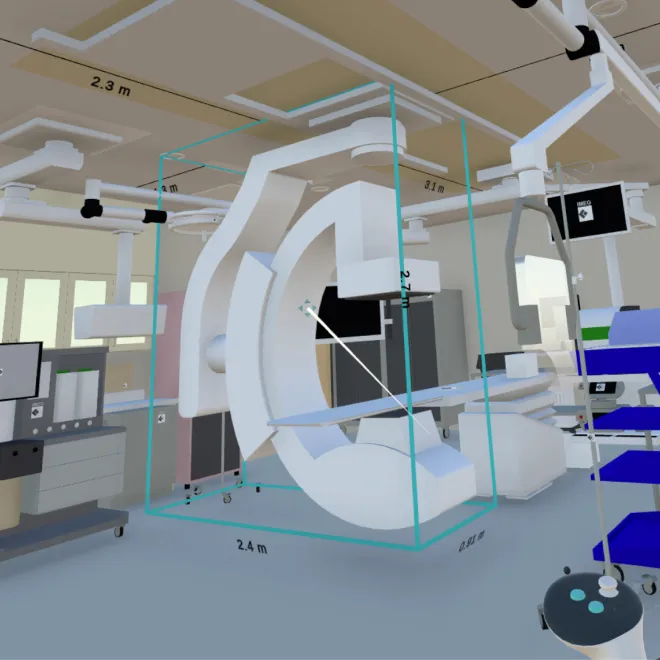
That is especially valuable on healthcare projects, where equipment placement, access clearances, and staff workflow all matter. In Arkio, IMEG can quickly compare layout option 1 versus layout option 2 at full scale, or simulate how equipment will move through a building to verify clearances and workflows before construction.
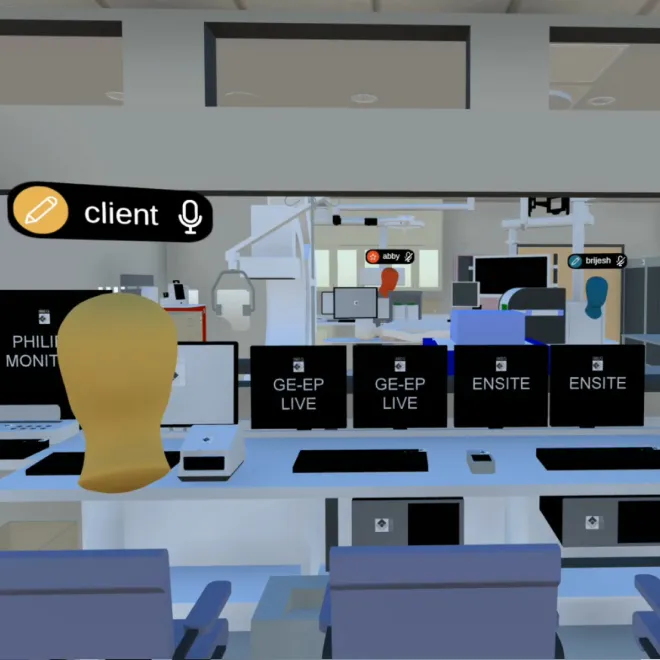
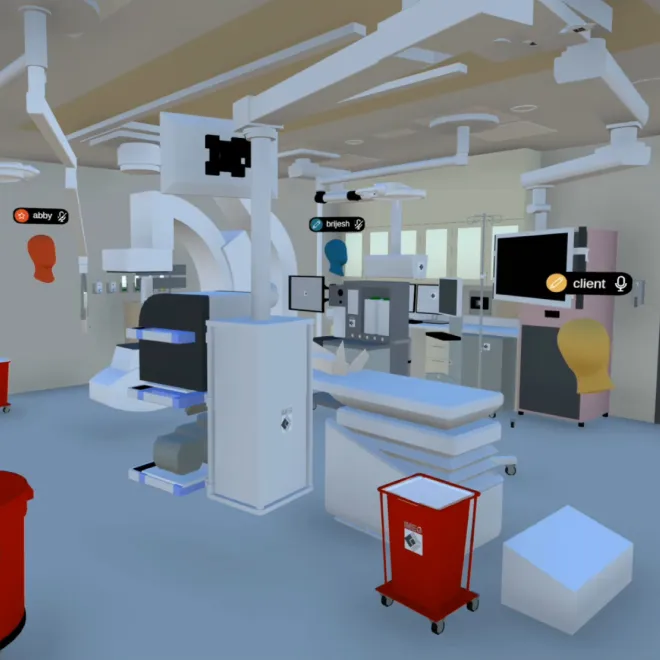
Arkio's cross-platform access and licensing flexibility also make it easier to scale these reviews across a large organization. Whether someone joins from a VR headset, PC, or mobile device, they can participate in the same immersive session from anywhere, expanding collaboration opportunities for internal teams and clients.
A Typical Arkio Workflow at IMEG
A typical Arkio workflow at IMEG often starts when a project team is working through a complex design challenge with a client. On a recent healthcare project focused on medical equipment planning, Arkio helped the team review the layout of a critical space where there were questions around equipment placement and workflow.
When the design intent is hard to understand through drawings or static 3D views, IMEG introduces VR so the client can better experience the space. During a design review, either remote or in person, the team brings the model into Arkio and walks through the room together. In remote meetings, one IMEG team member typically joins the Arkio session on a PC and shares their screen, moving medical equipment live within the model while everyone watches and discusses layout options in real time.
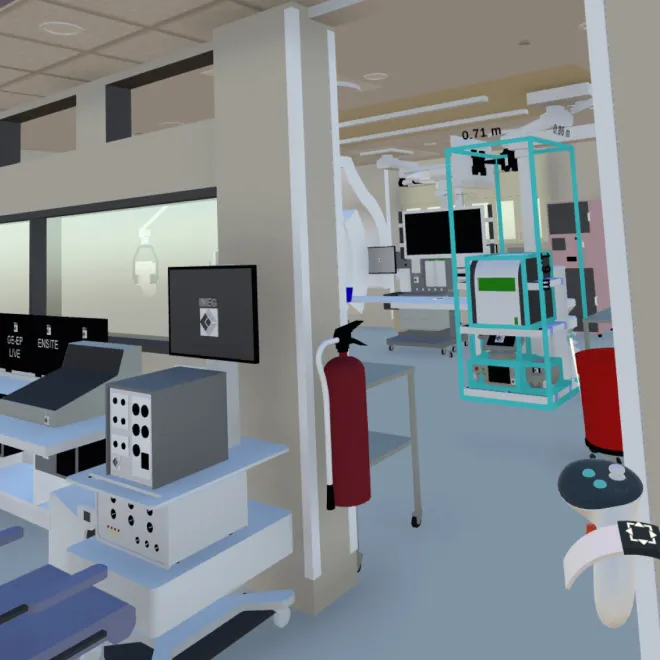
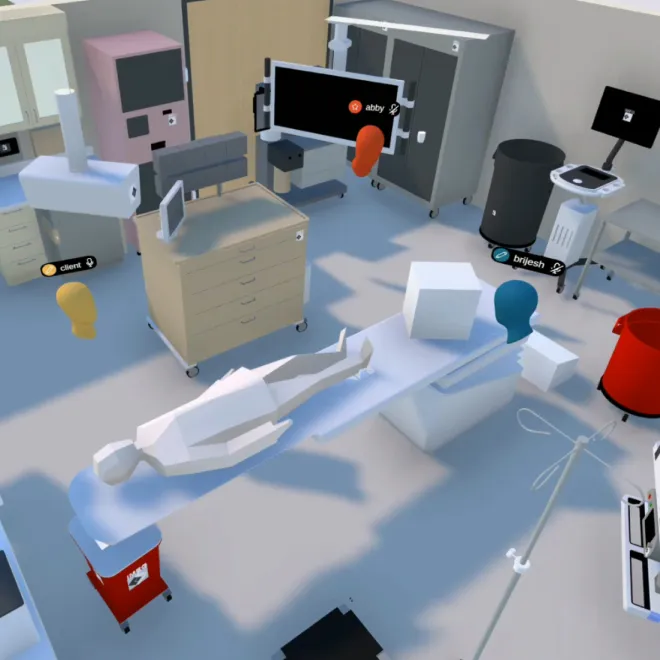
"Being able to adjust equipment directly from the PC is extremely valuable," Abby says, "because it allows the team to quickly test different scenarios and immediately see how those changes affect the space."
Arkio's notes and sketch tools are especially helpful during these sessions because they allow IMEG to capture feedback and ideas in real time as the conversation evolves. The paint tool has also become useful for color-coding different pieces of medical equipment, helping the team and client quickly understand the layout and function of the space during the review.
Where Arkio Fits in the Design Process
At IMEG, Arkio adds value throughout the project lifecycle. During schematic design and early planning, it allows teams and clients to step into conceptual layouts and better understand spatial relationships before designs are finalized. As projects move into later stages, Arkio becomes especially useful for refining layouts, validating equipment placement, and reviewing stakeholder workflows.
Being able to walk through critical spaces at full scale helps teams confirm that designs function as intended before construction begins. Arkio also fits well into the tools IMEG already uses, including Revit, Navisworks, Rhino, and SketchUp, and can be accessed through VR headsets, desktop computers, and mobile devices.
On renovation projects, IMEG can import point cloud data to visualize existing conditions and explore design options within the real environment. That allows engineers and clients to test "what if" scenarios in real time, such as moving equipment, evaluating clearances, or understanding how future installations will function within the space.
Better Alignment, Faster Decisions
Immersive design reviews have significantly improved how IMEG teams collaborate and make decisions. By allowing engineers, architects, and clients to experience spaces at full scale, VR helps identify layout conflicts, equipment access concerns, and workflow challenges that can be difficult to catch in traditional drawings. Addressing these issues earlier helps teams resolve potential problems before they become larger coordination issues later.
Client feedback has been overwhelmingly positive. Many stakeholders say that reviewing designs in VR makes complex spaces far easier to understand than looking at 2D plans alone. In some cases, immersive sessions have been rated around 9 out of 10 in terms of usefulness, and they often help teams reach alignment faster, reducing the need for additional meetings and revisions.
Across IMEG's immersive design workflows, VR has helped improve communication, accelerate decision-making, and give both design teams and clients greater confidence in the final design.
Looking Ahead
IMEG is now looking more closely at Arkio's mixed reality and mapping capabilities. "Mixed reality opens up new opportunities for how we visualize and interact with designs in real-world environments," Abby says.
She sees potential to use Arkio during groundbreaking ceremonies, for on-site visualization, and as a way to explore renovation scenarios by placing and moving equipment within an existing space in an immersive and interactive way.
The map feature is also promising for understanding how new buildings fit within their surrounding context, including sight lines and relationships to existing structures. As immersive technology continues to evolve, IMEG sees Arkio playing an even larger role in interactive design exploration, stakeholder engagement, and on-site visualization.
Who Benefits Most
Abby says she would absolutely recommend Arkio to other firms exploring immersive collaboration, especially teams working on complex spaces where layout, equipment placement, and workflow are critical to project success.
"Tools like Arkio make it much easier for teams and clients to experience designs at full scale and have more productive conversations around layout, workflow, and spatial coordination," she says. "One of the biggest advantages is the ability to move Revit families directly within the immersive environment, allowing teams to explore ideas and make adjustments in real time."
For IMEG, the clients often benefit most. Engineers are typically comfortable interpreting 2D floor plans, but many clients are not. Allowing them to experience a project in a 3D immersive environment helps them better understand the design, ask more informed questions, and provide meaningful feedback earlier in the process.
Abby also points to the support behind the product. "The Arkio team has been incredibly supportive and responsive, often jumping on calls to share tips and help us get the most out of the platform."

Abby Coleman, Innovation Extended Reality Specialist at IMEG
"Being able to step inside the model together helps teams reach alignment faster and gives stakeholders a clearer understanding of the design."